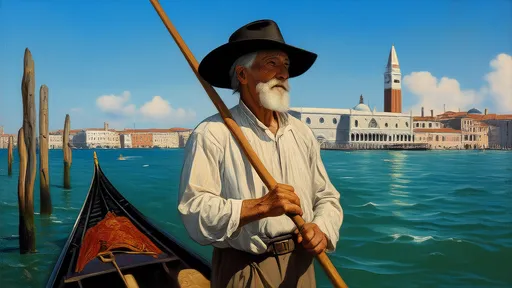
In the labyrinthine canals of Venice, where the Adriatic whispers against ancient stone, the gondoliers ply their trade with a rhythm unchanged by centuries. These custodians of the waterways are more than mere ferrymen; they are the living heirs of a maritime tradition that once connected Europe to the silk and spice routes of the East. Their gondolas—black, sleek, and asymmetrical—cut through the water like needles stitching together the past and present of a city built on trade, myth, and salt.
The profession of gondolier is not simply a job but a lineage, passed down through generations like a carefully guarded secret. To become a gondolier is to inherit a legacy that demands mastery of geography, linguistics, and an almost poetic understanding of Venice’s liquid streets. The training is grueling, lasting years, and includes memorizing over 100 canals and 400 bridges while mastering the art of single-oar navigation—a technique unique to these waterways. Few professions demand such intimacy with a city’s soul.
The gondola itself is a marvel of craftsmanship, each one requiring months of labor by specialized artisans. Made from eight types of wood and weighing over 600 pounds, its design is a study in hydrodynamic efficiency, perfected over a millennium. The ferro, the iconic iron prow, serves as both counterweight and symbol: its six teeth represent Venice’s six sestieri (districts), while the curved top echoes the Doge’s cap. These vessels were once the taxis of a maritime empire; today, they are floating museums, though their keepers would scoff at such a static description.
What few tourists realize is that the gondoliers are the last practitioners of a dialect as rare as the city’s foundations. Their ‘Venexiàn’ phrases—called ‘remèr’—are nautical commands and greetings unchanged since Marco Polo’s era. When two gondoliers exchange a "Sào mi?" (Do you know me?) across the water, they’re reciting lines from a play first staged when Venice dominated Mediterranean trade. This linguistic heritage, more than any souvenir, is the real treasure carried in their boats.
The twilight hours reveal the gondoliers’ other role: as keepers of oral history. Between sunset and the last cruise, they become raconteurs, recounting how their great-grandfathers transported Casanova or outmaneuvered Habsburg tax collectors. Some stories are embellished, no doubt, but the throughline is truth—how these families navigated plagues, wars, and the slow sinking of their city without ever abandoning their posts. The most revered among them can trace their lineage back to the 14th-century ‘Fraglia dei Gondolieri’, the original guild that regulated fares and resolved disputes with Venetian efficiency.
Modernity has not been kind to this tradition. Where 10,000 gondolas once plied the canals during the Republic’s zenith, now fewer than 400 remain, most serving tourists rather than locals. The ‘squaeri’ (gondola workshops) that once dotted the city now number just three. Yet the gondoliers persist, adapting without surrendering. Some have traded folk songs for smartphone playlists, but they still row with the same precise twist of the wrist their ancestors used to avoid Ottoman patrols. Others have become amateur historians, correcting guidebooks with the precision of scholars.
Perhaps the most remarkable survival is the ‘voga alla veneta’—the standing rowing style that defies physics. Unlike any other rowing tradition worldwide, it requires balancing on the gondola’s stern while pushing (not pulling) the oar—a technique born from needing to see over canal walls in the age of silk-laden barges. This method, now taught to a handful of female rowers (the profession was male-only until 2010), remains the ultimate expression of Venetian ingenuity—a city that built its wealth by turning limitations into art.
As cruise ships dwarf the skyline and acqua alta floods the piazzas, the gondoliers have become accidental activists. Their daily battles against wake from motorboats preserve the canal walls; their insistence on handmade oars sustains dying woodcraft. When they gather at the ‘traghetto’ stations—those few remaining spots where locals still cross canals for two euros—they’re not just sharing gossip but strategizing how to keep their art alive. Some have begun training apprentices from non-gondolier families for the first time, recognizing that survival may require breaking with tradition.
The future of this living heritage hangs in the balance, much like Venice itself. UNESCO recognition has brought scrutiny but little practical aid. The gondoliers’ greatest threat isn’t disinterest but commodification—being reduced to costumed attractions rather than recognized as the last thread connecting the modern city to its mercantile soul. Yet when the morning mist rises off the Grand Canal, and the first "Ohé!" call echoes between palazzos, it’s clear that these watermen still hold the memory of the Serenissima in their oar strokes. They remain, as ever, the unbroken link to when Venice was not a postcard but the beating heart of the world’s first global economy.

By /Jun 10, 2025
By /Jun 10, 2025
By /Jun 10, 2025

By /Jun 10, 2025

By /Jun 10, 2025

By /Jun 10, 2025

By /Jun 10, 2025
By /Jun 10, 2025

By /Jun 10, 2025

By /Jun 10, 2025

By /Jun 10, 2025
By /Jun 10, 2025

By /Jun 10, 2025
By /Jun 9, 2025
By /Jun 9, 2025

By /Jun 9, 2025
By /Jun 9, 2025
By /Jun 9, 2025
By /Jun 9, 2025
By /Jun 9, 2025
