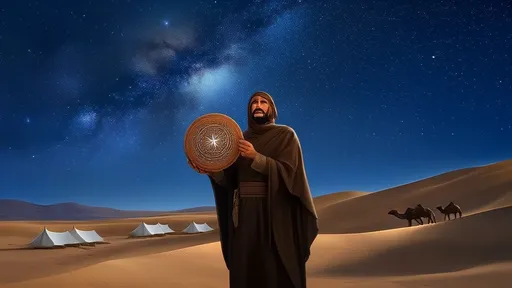
The vast expanse of the Sahara Desert, with its shifting dunes and relentless sun, has long been a formidable challenge for travelers. Yet, for centuries, the nomadic Berber people have traversed this unforgiving landscape with remarkable precision, guided not by compasses or maps, but by the stars. Their intricate knowledge of the night sky, passed down through generations, reveals a celestial navigation system as sophisticated as it is ancient.
For the Berbers, the Milky Way is not merely a spectacle of light; it is a roadmap etched across the heavens. Known as "Tasaft n Uḍar"—the "Path of the Land"—the galaxy serves as a central axis for orientation. Unlike Western navigators who rely on the North Star, Berber nomads read the galaxy’s position, curvature, and brightness to determine direction and even predict seasonal changes. The stars are their landmarks, and the darkness, their guide.
Oral tradition is the lifeblood of this celestial wisdom. Elders teach the younger generations to recognize constellations like Afara (Orion’s Belt), which signals the arrival of winter, or Tanit (the Pleiades), whose rising heralds the planting season. The stories woven around these stars are not myths but mnemonic devices, ensuring that the knowledge survives in a culture where written records are scarce. Every twinkling light has a name, a purpose, and a place in the grand tapestry of navigation.
The Berbers’ star lore is deeply intertwined with their environment. They divide the sky into four quadrants, each corresponding to a cardinal direction and a specific terrain feature—a mountain, a well, or a wadi. By aligning the Milky Way with these mental markers, they can pinpoint their location even in featureless desert. This method, honed over millennia, is so precise that modern researchers have documented cases of nomads arriving at distant oases with minimal deviation.
Yet, this ancient practice faces an existential threat. Light pollution from growing settlements, the encroachment of modern technology, and the sedentarization of younger generations are eroding the Berbers’ connection to the stars. Fewer nomads now undertake the long caravans that once demanded celestial navigation, and with each elder who passes, a fragment of this cosmic knowledge fades.
Efforts to preserve this heritage are emerging. Anthropologists and astronomers collaborate with Berber communities to document their star maps, while cultural initiatives integrate celestial navigation into school curricula. The goal is not to fossilize tradition but to ensure its adaptation—a fusion of ancestral wisdom and contemporary tools.
The Sahara’s nomads remind us that navigation is more than a physical journey; it is a dialogue with the cosmos. In their star maps, we find a testament to human ingenuity—a way of seeing the world that transforms the heavens into a compass, and the night, a companion.
By /Jun 10, 2025

By /Jun 10, 2025

By /Jun 10, 2025

By /Jun 10, 2025

By /Jun 10, 2025
By /Jun 10, 2025

By /Jun 10, 2025
By /Jun 10, 2025

By /Jun 10, 2025

By /Jun 10, 2025
By /Jun 10, 2025

By /Jun 10, 2025

By /Jun 10, 2025

By /Jun 9, 2025

By /Jun 9, 2025

By /Jun 9, 2025

By /Jun 9, 2025

By /Jun 9, 2025

By /Jun 9, 2025

By /Jun 9, 2025
