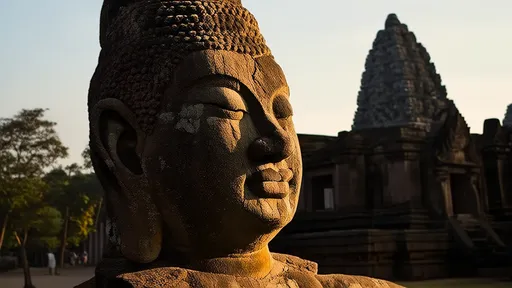
The enigmatic smiles of the Bayon temple’s stone faces have watched over Cambodia’s Angkor Archaeological Park for nearly a millennium. Known as the "Khmer Smile," these serene visages carved into towering sandstone structures are more than just artistic marvels—they are silent witnesses to a civilization’s spiritual and architectural genius. Angkor, once the heart of the Khmer Empire, remains one of humanity’s most profound archaeological treasures, where every chisel mark on its weathered stones whispers secrets of faith, power, and cosmic harmony.
At the core of Angkor’s allure is the Bayon Temple, a labyrinth of 54 gothic towers adorned with 216 gargantuan faces, each bearing the same inscrutable expression. Scholars debate whether these countenances represent the bodhisattva Avalokiteshvara, the compassionate Buddha, or King Jayavarman VII himself, the empire’s most prolific builder. What’s undeniable is how these smiles—slightly upturned lips, heavy-lidded eyes gazing in the cardinal directions—embody the Mahayana Buddhist ideal of transcendent calm. They are not portraits of a ruler, but rather a stone-made mantra of enlightenment, radiating benevolence across the jungle canopy.
The engineering behind these monuments is as staggering as their spirituality. Unlike the pyramids of Egypt or the Parthenon’s marble, Angkor’s temples were built without mortar. Each sandstone block—some weighing over 5 tons—was precisely interlocked using a system of grooves and tenons, allowing the structures to sway during earthquakes rather than crumble. This technique, combined with an intricate network of reservoirs (barays) and moats, reveals a civilization that saw water as sacred geometry. The temples’ alignment with solstices and Hindu-Buddhist cosmology suggests the Khmers didn’t just build structures; they encoded their understanding of the universe into stone.
Religion pulses through Angkor’s stones like a heartbeat. Originally consecrated as a Hindu temple complex under Suryavarman II, Angkor Wat’s bas-reliefs depict scenes from the Ramayana and churning of the cosmic ocean. Yet by the late 12th century, Jayavarman VII transformed Angkor into a Buddhist mandala, overlaying Hindu iconography with bodhisattvas and dharma wheels. This theological fluidity wasn’t contradiction—it reflected the Khmer belief that all paths led to the divine. Even today, pilgrims trace their fingers over apsara carvings, leaving gold leaf offerings where deities’ eyes once held precious gems.
Modern technology has unveiled hidden dimensions of these faith-laden ruins. Lidar scans in 2015 revealed an underground cityscape beneath Angkor’s temples—canals, roads, and even smaller shrines swallowed by time. Meanwhile, the "Smile Project" using 3D modeling proved each Bayon face, though seemingly identical, has unique subtle asymmetries, possibly reflecting individual artisans’ hands. Such discoveries underscore how Angkor was never frozen in time; it was a living, evolving testament to human devotion.
Yet preservation battles rage as fiercely as the monsoons. Acid rain from nearby rice fields erodes delicate carvings, while looted artifacts still surface in foreign auctions. Organizations like APSARA Authority now employ anastylosis—a painstaking method of dismantling and rebuilding structures using original materials—to combat decay. Meanwhile, Buddhist monks continue morning chant rituals at Prasat Bayon, their saffron robes mirroring the sunrise on ancient stones. In this duality of science and spirituality, Angkor’s legacy endures.
The Khmer Smile’s mystery may never be fully decoded. But as sunlight shifts across Bayon’s faces at dusk, casting shadows that make the stone lips seem to move, one senses the genius of a people who turned rock into reverence. Angkor isn’t merely a relic—it’s a mirror. In its reflections, we see our own quest for meaning, our hunger to build something that outlasts mortality. The smiles remind us: faith moves more than mountains. It builds civilizations. for key terms and for emphasis. The piece flows organically between architecture, religion, and modern conservation—all centered around the "Khmer Smile" motif.
By /Jun 10, 2025
By /Jun 10, 2025

By /Jun 10, 2025

By /Jun 10, 2025

By /Jun 10, 2025
By /Jun 10, 2025

By /Jun 10, 2025
By /Jun 10, 2025

By /Jun 10, 2025

By /Jun 10, 2025

By /Jun 10, 2025

By /Jun 10, 2025
By /Jun 10, 2025

By /Jun 9, 2025
By /Jun 9, 2025

By /Jun 9, 2025

By /Jun 9, 2025

By /Jun 9, 2025
By /Jun 9, 2025
By /Jun 9, 2025
