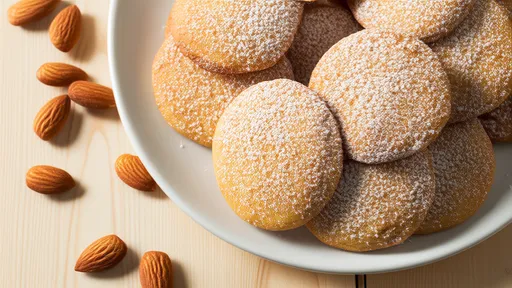
The art of crafting Austrian snowball cookies, known for their delicate crumb and nutty aroma, hinges on two often-overlooked factors: the precise granulometry of nut particulates and the nuanced hand techniques employed during dough rounding. These variables transform what might appear as simple ingredients into textural masterpieces that have graced Viennese coffeehouses for generations.
Nut particle size distribution proves far more critical than most home bakers realize. Traditional recipes calling for "finely ground hazelnuts" fail to convey the microscopic drama occurring within the dough matrix. Professional confectioners recognize that a bimodal distribution - combining 60% flour-like powder with 40% granules measuring 0.5-1mm - creates optimal structural integrity. The finer particles hydrate uniformly with butter and flour, while the slightly coarser fragments provide intermittent resistance that prevents excessive gluten development during mixing.
Industrial bakeries achieve this through calibrated milling, but home practitioners can approximate the ideal texture through a fascinating technique. Roasted nuts are first pulsed in a food processor with 10% of the recipe's powdered sugar, which acts as an anti-caking agent. The mixture is then sifted through a tea strainer, with any remaining coarse bits deliberately retained rather than reprocessed. This method honors the Austro-Hungarian tradition of "gebrochene Struktur" - the broken structure that gives these cookies their signature shortbread-like collapse.
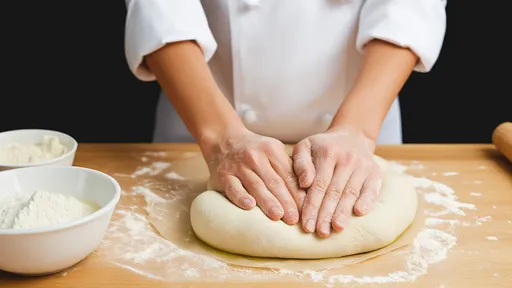
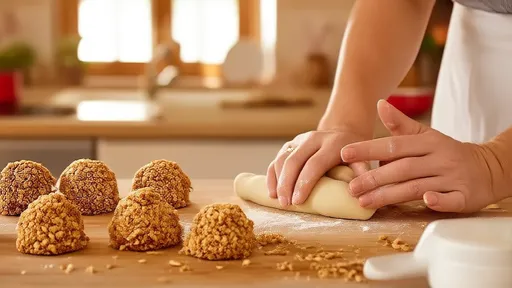
The rounding technique reveals even deeper layers of craftsmanship. Unlike the aggressive palm-rolling common in American baking, Austrian masters employ a three-phase approach using only fingertips. Initially, portioned dough is gently compressed just enough to eliminate air pockets, then rotated between thumb and middle finger to create surface tension. The final motion - a barely perceptible downward drag against the work surface - aligns protein strands horizontally, ensuring even radial cracking during baking. This accounts for the snowball's characteristic fissured appearance.
Temperature variables introduce another dimension to the process. Professional kitchens maintain dough at precisely 14-16°C during shaping, a range where butter remains plastic but doesn't smear. The ambient paradox of warm hands working cool dough explains why winter months historically yielded superior batches. Contemporary bakers achieve this control by chilling stainless steel bowls and periodically dipping hands in ice water, then thoroughly drying them to prevent moisture absorption.
Nut variety selection impacts both grinding behavior and final texture. While hazelnuts dominate modern recipes, archival sources reveal walnut-based versions were equally prevalent in imperial Vienna. The higher oil content in walnuts demands adjusted processing - freezing the kernels to -18°C before grinding prevents nut butter formation. Almonds, when used, require blanching to remove skins that would otherwise create undesirable flecks in the pale cookies. Each nut type brings distinct thermal conductivity to the dough, affecting how quickly the center sets during baking.
The relationship between particle geometry and baking expansion has been quantified in surprising ways. Using laser diffraction analysis, researchers at Graz University found that irregularly shaped nut fragments create micro-channels for steam escape, preventing the hollow centers that plague uniform doughs. This explains why professional bakers intentionally vary their grinding intensity rather than seeking perfect homogeneity. The ideal crumb structure contains voids measuring 50-200 microns, visible only under magnification but detectable as sublime lightness on the tongue.
Traditional shaping tools tell their own story. Antique wooden work boards often feature subtle concavities worn by generations of consistent hand motions. Museum collections in Salzburg preserve century-old horn scrapers used to gather dough without incorporating excess flour. Even the direction of rotation carries significance - clockwise in Alpine regions, counterclockwise near the Hungarian border, creating minor but measurable differences in surface tension patterns.
Modernist bakeries have experimented with extreme nut preparations, from cryo-ground pistachios to lipid-reduced macadamia flour. Yet the most convincing innovations often return to historical methods. One Michelin-starred Vienna patisserie revived an 1890s technique of toasting nuts in clarified butter before grinding, which modifies starch gelatinization behavior during baking. Another revives the obscure practice of layering differently ground nuts - fine at the core, coarse near the surface - to engineer specific fracture points.
The humble snowball cookie, often dismissed as simple holiday fare, emerges as a masterpiece of materials science when examined through this lens. From the quantum interactions of nut fragments with gluten networks to the thermodynamics of fingertip pressure, these unassuming spheres encode centuries of empirical knowledge. As contemporary bakers increasingly value technique over mere recipe replication, the hidden complexities of Austrian pastry craft gain new appreciation - one precisely ground nut and deliberately rotated dough ball at a time.
By /Jun 19, 2025
By /Jun 19, 2025
By /Jun 19, 2025

By /Jun 19, 2025
By /Jun 19, 2025

By /Jun 19, 2025
By /Jun 19, 2025
By /Jun 19, 2025
By /Jun 19, 2025
By /Jun 19, 2025
By /Jun 19, 2025

By /Jun 19, 2025
By /Jun 19, 2025
By /Jun 19, 2025
By /Jun 19, 2025
By /Jun 19, 2025
By /Jun 18, 2025
By /Jun 18, 2025
By /Jun 18, 2025
By /Jun 18, 2025
