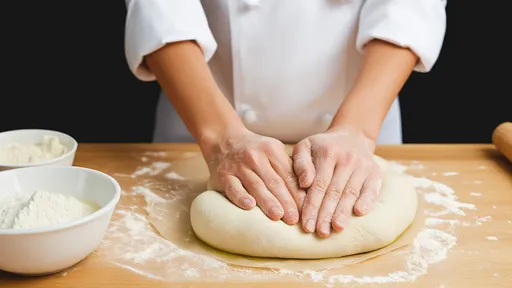
In the world of baking, few things are as frustrating as dealing with sticky dough that clings to your fingers like glue. Seasoned bakers have developed various techniques to handle this common issue, with the oiled hands method and flour dusting being two of the most popular approaches. However, finding the perfect balance between effective dough handling and maintaining the dough's integrity requires understanding the subtle art of quantity control.
The oiled hands technique has gained popularity among professional bakers for its ability to create a protective barrier between skin and dough without altering the dough's composition. When executed properly, this method allows for smooth manipulation of even the wettest ciabatta or focaccia doughs. The key lies in using just enough oil to coat the hands thinly - typically a teaspoon or less for average home baking quantities. Over-oiling can lead to greasy dough that struggles to develop proper gluten structure, while under-oiling defeats the purpose entirely.
On the other side of the spectrum lies the traditional flour dusting approach, a method passed down through generations of bakers. While seemingly straightforward, the precise amount of flour used makes all the difference. Professional kitchens often measure additional flour in grams rather than cups when adjusting stickiness, as even 10-15 grams can significantly impact the dough's final texture. The invisible threshold between just enough and too much flour represents one of baking's most delicate balances.
Understanding the dough's hydration level proves crucial in determining which method to employ. High hydration doughs above 75% often respond better to oiled hands, as adding more flour would fundamentally change the recipe's character. Conversely, moderately hydrated doughs in the 60-70% range can tolerate small flour adjustments while maintaining their essential qualities. This distinction explains why artisan bread bakers frequently reach for oil when handling their 80% hydration masterpieces.
The temperature factor often goes overlooked in discussions about dough stickiness. Warmer dough tends to feel stickier as the gluten becomes more relaxed and the fats within soften. This explains why many bakers report better results with the oil method during summer months or in warm kitchens, while flour dusting seems more effective in cooler environments. The dough's temperature essentially changes its reaction to both handling techniques, requiring bakers to adapt their approach seasonally.
Equipment surfaces present another consideration in the sticky dough equation. Many professional bakers employ a dual approach - oiled hands for dough handling combined with a lightly floured work surface. This hybrid method prevents excessive flour incorporation while still providing the necessary release from countertops. The precise ratio varies depending on the dough type, with enriched doughs often requiring more oil and lean doughs tolerating slightly more flour.
Modern baking science has revealed why these two methods affect dough differently at the molecular level. Oil creates a hydrophobic barrier that prevents starch molecules from bonding with water on the skin's surface, while flour absorbs excess moisture and provides physical separation. This fundamental difference explains why over-flouring can lead to dense baked goods while over-oiling may cause structural issues - they interact with the dough's chemistry in distinct ways.
Cultural baking traditions have developed fascinating variations on these techniques. Italian bakers working with high-moisture doughs historically used olive oil not just for flavor but for practical handling. Meanwhile, French boulangers perfected the art of minimal flour dusting to maintain the open crumb structure of their iconic baguettes. These regional approaches demonstrate how environmental factors and desired outcomes shape handling methods.
The psychological aspect of dough handling shouldn't be underestimated. Many novice bakers instinctively add too much flour because sticky dough feels "wrong," despite being perfectly normal for certain recipes. Overcoming this instinct represents a significant hurdle in skill development. Professional bakers learn to judge dough by its behavior rather than its initial tactile impression, recognizing that proper development often reduces stickiness naturally during the kneading process.
Recipe scaling introduces another layer of complexity to the sticky dough dilemma. A tablespoon of oil that works perfectly for a home baker's two-loaf batch becomes impractical in commercial operations mixing 50-pound batches. Large-scale bakeries often develop customized solutions involving food-grade release sprays or specialized equipment that home bakers wouldn't require. This scaling factor highlights why professional techniques don't always translate directly to home kitchens.
Experimentation remains the ultimate teacher when navigating the nuances of sticky dough management. Keeping detailed notes on oil quantities, flour adjustments, and environmental conditions helps bakers develop their personalized approach. Over time, hands develop a kind of muscle memory for the exact amount of slickness needed when using oil or the precise dusting motion required with flour. This tactile knowledge, impossible to fully convey in recipes, separates competent bakers from true artisans.
The debate between oil and flour ultimately comes down to the desired final product. Crispy, flour-dusted artisan loaves benefit from minimal bench flour during shaping, while ultra-soft sandwich breads might require oil to prevent toughening. Understanding how each method affects the finished baked good's texture, crust, and keeping qualities allows bakers to make informed choices rather than relying on guesswork.
Seasonal ingredient variations add another wrinkle to the sticky dough challenge. Flour absorbed more moisture in humid summers than in dry winters, while butter quality fluctuates throughout the year. These subtle changes require corresponding adjustments in handling methods - perhaps a bit more oil during rainy seasons or slightly less flour when working with particularly absorbent winter wheat. The most skilled bakers develop an intuitive sense for these seasonal shifts.
Modern ingredient innovations have introduced new possibilities in dough handling. Some professional kitchens now use rice flour for dusting as it absorbs less moisture than wheat flour. Others employ silicone baking mats that reduce the need for either oil or flour. These developments don't eliminate the fundamental choice between oil and flour methods but do expand the range of options available to today's bakers.
The sensory experience of dough handling holds valuable clues for method selection. Well-developed dough often becomes less sticky as the gluten organizes itself, signaling when minimal intervention suffices. Recognizing these textural changes helps bakers determine whether to use oil, flour, or simply patience. This dynamic aspect of dough behavior means the optimal handling method might change throughout the baking process.
Ultimately, mastering sticky dough represents a rite of passage in a baker's journey. Whether choosing the sleek efficiency of oiled hands or the time-honored tradition of flour dusting, the decision reflects both practical considerations and philosophical approaches to baking. The most successful bakers don't rigidly adhere to one method but rather develop the wisdom to know when each approach serves them best, sometimes combining both within a single recipe. This flexibility, born of experience and understanding, transforms sticky dough from a frustration into an opportunity for artistry.
By /Jun 19, 2025
By /Jun 19, 2025
By /Jun 19, 2025

By /Jun 19, 2025
By /Jun 19, 2025

By /Jun 19, 2025
By /Jun 19, 2025
By /Jun 19, 2025
By /Jun 19, 2025
By /Jun 19, 2025
By /Jun 19, 2025

By /Jun 19, 2025
By /Jun 19, 2025
By /Jun 19, 2025
By /Jun 19, 2025
By /Jun 19, 2025
By /Jun 18, 2025
By /Jun 18, 2025
By /Jun 18, 2025
By /Jun 18, 2025
